





 Quick Answer
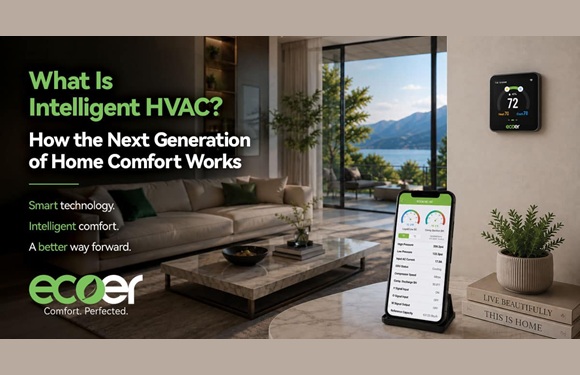
Intelligent HVAC is a system-level approach to heating and cooling that combines adaptive equipment operation with connected monitoring, controls, diagnostics, and service information. Instead of simply turning on and off in response to a thermostat, an intelligent HVAC system can adjust to changing conditions and provide useful performance data that supports comfort, efficiency, installation quality, and long-term service.
Heating and cooling technology is changing. For decades, most residential HVAC systems followed a relatively simple pattern: a thermostat called for heating or cooling, the equipment turned on, and it stopped when the set temperature was reached. Today’s most advanced systems can do much more. They can adjust capacity as conditions change, monitor their own operation, communicate performance information, support remote diagnostics, and give HVAC professionals better information throughout the life of the equipment.
That broader approach is what we mean by intelligent HVAC. It is not one device, app, thermostat, or efficiency rating. It is an HVAC system designed so that equipment, controls, data, monitoring, diagnostics, installation, and service work together to support more consistent comfort with greater system visibility.
For homeowners, the technology should largely stay in the background. The result should feel simple: steadier temperatures, quieter operation, better humidity control, and greater confidence in system performance. For contractors, intelligence means more visibility into how equipment is installed, commissioned, operating, and behaving over time.
Key Takeaway
Intelligent HVAC is not the same thing as a smart thermostat. The thermostat is one interface. The intelligence comes from how the HVAC equipment, controls, sensors, data, and service tools work together.
What Is Intelligent HVAC?
Definition: Intelligent HVAC is a connected, adaptive approach to heating and cooling in which the equipment can respond to changing conditions, communicate operating information, and support more informed installation, monitoring, diagnostics, and service.
There is no single industry certification that defines the phrase “intelligent HVAC.” The term is most useful when it describes a complete system philosophy rather than a marketing label. A system should not be considered intelligent simply because it has Wi-Fi or can be controlled from a phone.
A meaningful intelligent HVAC system typically brings together several capabilities:
- Variable-capacity or inverter-driven operation that can adjust heating and cooling output to changing demand.
- Sensors and controls that provide information about how the equipment is operating.
- Connected monitoring that can make system status and operating history more visible.
- Diagnostic capabilities that can give qualified HVAC professionals additional context before or during service.
- Commissioning and installation tools that help reduce setup uncertainty.
- A service ecosystem that turns system information into useful decisions rather than simply generating more data.
Important Distinction
“Connected,” “smart,” and “intelligent” are related ideas, but they are not automatically interchangeable. Connectivity moves information. Intelligence makes that information useful in the operation, installation, monitoring, or service of the HVAC system.
How Does an Intelligent HVAC System Work?
An intelligent HVAC system works as an ecosystem. The exact design varies by manufacturer, but the basic progression is similar:
| Sense | Adjust | Monitor | Interpret | Support |
|---|---|---|---|---|
| Equipment and sensors collect operating information | Controls and inverter technology respond to changing demand | Connected systems communicate status and history | Diagnostics help turn data into useful context | Contractors use that context for installation, maintenance, and service |
The goal is not to automate every decision or remove the HVAC professional. It is to reduce the amount of guesswork surrounding how a system starts, operates, and changes over time.
Variable-speed operation is a good example. The U.S. Department of Energy explains that inverter-driven heat pumps can modulate capacity between low and high output instead of relying only on repeated on/off cycles, helping them operate efficiently while maintaining more consistent comfort. See the Department of Energy’s overview of advanced heat pump technologies.
Pro Tip
When comparing intelligent HVAC systems, ask what the equipment itself can sense, adjust, record, and communicate. A mobile app is useful, but the deeper question is what is happening inside the HVAC system and what information is available to the professional responsible for it.
Smart HVAC vs. Intelligent HVAC
The HVAC industry uses the word “smart” broadly. In some products, smart simply means remote thermostat control. An intelligent HVAC system takes a wider, system-level view.
| Capability | Basic Smart HVAC | Intelligent HVAC Approach |
|---|---|---|
| Primary focus | Remote control and scheduling | System performance across operation, monitoring, installation, and service |
| Equipment response | May still use fixed or staged operation | Can include variable-capacity or inverter-driven adjustment |
| Visibility | Often centered on thermostat status | Can include equipment-level status, history, alerts, and diagnostics |
| Service model | Problems may still begin with a homeowner complaint | Connected information can provide added context before or during service |
| Installation support | Limited | Can include commissioning and setup tools |
| Role of data | Shows information to the user | Supports decisions for homeowners and HVAC professionals |
These categories overlap, and individual systems vary. The useful distinction is whether the technology mainly adds convenience at the thermostat or supports the performance of the HVAC system throughout its lifecycle.
COMMON MISTAKE
Do not assume that every Wi-Fi thermostat creates an intelligent HVAC system. A thermostat can be smart while the underlying heating and cooling equipment still provides little operating visibility or diagnostic information.
The Technologies Behind Intelligent Comfort
Intelligent comfort is created by multiple technologies working together. No single feature can deliver the complete experience.
1. Variable-Speed and Inverter-Driven Performance
Traditional single-stage equipment generally operates at full output whenever heating or cooling is required. Variable-capacity systems can adjust output as conditions change. That can support longer, steadier operating cycles, more consistent indoor temperatures, quieter operation, and improved humidity control when the equipment and system are properly designed and installed.
For a deeper comparison, see Inverter Heat Pumps vs. Traditional HVAC Systems.
2. Connected Monitoring
Connected monitoring creates visibility between service visits. Instead of evaluating the system only during annual maintenance or after a comfort complaint, qualified HVAC professionals may be able to review current or historical operating information, alerts, and system conditions.
Ecoer explores this service model in How IoT HVAC Monitoring Improves Long-Term Home Comfort.
3. Remote Diagnostics
Remote diagnostics do not repair equipment from a distance. They provide information. Historical performance, fault codes, alerts, temperatures, pressures, runtime, and other available data can give a technician more context when evaluating a system.
This concept has been studied beyond manufacturer marketing. Pacific Northwest National Laboratory has evaluated automatic fault detection and diagnostics in residential central air conditioners and air-source heat pumps, including embedded diagnostics and smart diagnostic tools intended to support installation and service. Read the PNNL residential AFDD market analysis.
4. Intelligent Commissioning and Installation Support
An HVAC system does not become intelligent only after installation. Some of the greatest opportunities for technology begin during setup and commissioning. Correct refrigerant charge, airflow, equipment sizing, and system configuration all affect real-world performance.
ENERGY STAR identifies proper sizing, airflow, refrigerant charge, and duct performance as core elements of HVAC quality installation. See ENERGY STAR’s HVAC Quality Installation guidance.
Key Takeaway
Intelligence should connect the full HVAC lifecycle: equipment design → installation → commissioning → daily operation → monitoring → diagnostics → service.
Why Intelligent HVAC Can Improve Home Comfort
Homeowners do not experience HVAC technology as data, compressor speed, algorithms, or fault codes. They experience the result. A well-designed intelligent HVAC system is valuable when its technology contributes to a better day-to-day comfort experience.
- More consistent temperatures. Variable-capacity operation can reduce the noticeable swings created by repeated full-output cycling.
- Quieter operation. Equipment that can operate below maximum output for part of the day may be less noticeable than equipment that repeatedly starts and stops at full capacity.
- Better humidity management. Longer, controlled cooling cycles and properly managed airflow can support indoor humidity control.
- Greater visibility. Connected information can help contractors understand how the system has been operating between visits.
- More informed service. Diagnostics and operating history can give technicians context beyond a single snapshot taken during a service appointment.
None of these benefits removes the need for correct design, quality installation, or regular professional maintenance. Intelligent technology is most valuable when it supports those fundamentals rather than trying to replace them.
DID YOU KNOW?
The most advanced HVAC technology may be nearly invisible to the homeowner. A successful intelligent system does not require the homeowner to manage more technical information; it uses that information behind the scenes to support comfort and service.
Intelligent HVAC Is More Than a Smart Thermostat
The easiest way to understand intelligent HVAC is to separate the interface from the system.
A smart thermostat can provide scheduling, remote control, occupancy features, and other conveniences. Those features can be valuable, but the thermostat does not automatically know everything happening inside the HVAC equipment.
An intelligent HVAC system extends beyond the thermostat. It can include inverter-driven equipment, onboard controls, sensors, monitoring hardware, cloud connectivity, diagnostic software, contractor tools, commissioning support, and historical operating information.
In other words, the thermostat is one point of interaction. The intelligence comes from the larger system.
MEMORABLE IDEA
A smart thermostat controls comfort. Intelligent HVAC helps the entire comfort system understand, adjust, communicate, and support service.
Why Installation and Commissioning Still Matter
Intelligent technology cannot overcome poor fundamentals. An advanced system that is incorrectly sized, improperly charged, restricted by poor airflow, or poorly commissioned may still deliver disappointing results.
That is why installation belongs inside the definition of intelligent comfort. The goal is not simply to build equipment with more features. The goal is to reduce uncertainty at the moments that matter most, beginning with installation and continuing through the life of the system.
Ecoer discusses the importance of setup in Why Refrigerant Charging Is One of the Biggest HVAC Installation Problems.
Ecoer’s Approach to Intelligent Comfort Technology
Ecoer is an Intelligent Comfort Technology Company. Its engineering approach connects equipment, data, intelligent controls, monitoring, diagnostics, installation support, and service to support greater consistency and visibility across the HVAC lifecycle.
For Ecoer, intelligent comfort is not defined by adding a connected feature to otherwise traditional equipment. It is a system philosophy built around reducing uncertainty and making performance more visible throughout the HVAC lifecycle.
| Ecoer Technology Area | How It Supports Intelligent Comfort |
|---|---|
| Inverter-driven systems | Adjust capacity to changing heating and cooling demand rather than relying only on fixed full-output operation. |
| Ecoer Pulse / connected monitoring | Communicates equipment and diagnostic information through Ecoer’s connected service ecosystem. |
| ESS Pro / Smart Service tools | Provide qualified HVAC professionals with remote monitoring, historical data, alerts, diagnostics, and system information. |
| Ecoer Automated Charging (EAC) | Supports refrigerant charging and commissioning on compatible Ecoer systems, helping reduce installation variability. |
| Smart thermostat and Ecoer Home | Give homeowners a simpler interface for comfort control while the broader system manages equipment operation and connectivity. |
Ecoer’s connected platform provides concrete examples of this approach. ESS Pro and Ecoer’s connected monitoring tools give qualified HVAC professionals access to system information, historical operating data, alerts, and diagnostic context that can support remote evaluation and more informed service decisions.
Ecoer Automated Charging (EAC), on applicable systems, supports refrigerant charging and commissioning to help reduce installation variability. These tools support qualified professional installation and service; they do not replace it.
Official Ecoer support: HVAC Monitoring Module | Ecoer FAQ / ESS | Ecoer Innovation & Product Information
The important point is not the number of features. It is how the pieces work together to support a more consistent comfort experience for the homeowner and a more informed workflow for the contractor.
ECOER PRINCIPLE
Technology should reduce variability—not increase complexity. Ecoer’s engineering approach supports greater consistency and visibility across installation, commissioning, operation, connected monitoring, diagnostics, and long-term professional service.
What Should Homeowners Look for in an Intelligent HVAC System?
When evaluating a new HVAC system, homeowners do not need to become technicians. A few practical questions can reveal whether “smart” features are mainly conveniences or part of a connected Intelligent HVAC approach that supports installation, operation, monitoring, diagnostics, and long-term service.
Does the contractor verify sizing, airflow, refrigerant charging, commissioning, and final system operation?
Why it matters: Intelligent technology works best when the fundamentals are correct. A meaningful answer should explain how the contractor confirms equipment sizing, airflow, refrigerant charge, system configuration, and final operation. Homeowners should confirm what measurements or commissioning steps are completed and verified. This helps show whether the system uses technology to support installation consistency rather than simply adding connected features after installation.
Does the system monitor the HVAC equipment itself, not only the thermostat or app?
Why it matters: A smart thermostat can provide convenient control without providing meaningful visibility into the heating and cooling equipment. A meaningful answer should identify what equipment-level information is available, such as system status, operating history, alerts, temperatures, pressures, runtime, or other applicable data. Homeowners should confirm what their specific system monitors and who can access that information. Equipment-level visibility is an important distinction between a smart interface and a more complete Intelligent HVAC system.
Can qualified professionals use system data, alerts, and operating history when evaluating potential issues?
Why it matters: Diagnostics are most useful when they provide trained professionals with additional context. A meaningful answer should explain what diagnostic information is available and how it can support troubleshooting or service preparation. Homeowners should confirm that remote diagnostics support professional evaluation and service decisions rather than automatically preventing failures or replacing an on-site service visit.
Does the manufacturer provide tools that support commissioning and installation accuracy?
Why it matters: Proper commissioning affects real-world comfort and performance. A meaningful answer should explain how available tools support applicable tasks such as refrigerant charging, system setup, commissioning, registration, and verification. Homeowners should confirm which capabilities apply to the exact equipment being installed and how the contractor verifies final setup. Intelligent HVAC should help reduce installation variability while keeping qualified professionals in the process.
Can the system identify or communicate alerts that may help guide service?
Why it matters: Connected information can give contractors greater visibility into system conditions between service visits. A meaningful answer should explain what types of alerts or operating information are available and how qualified professionals use them. Homeowners should confirm who receives the information and what follow-up may be required. Alerts and diagnostics can support earlier identification of potential issues, but they do not guarantee that failures will be predicted or prevented.
Can contractors continue accessing system information and service tools after installation?
Why it matters: Intelligent HVAC should extend beyond startup. A meaningful answer should explain whether qualified contractors can continue accessing applicable system status, operating history, alerts, diagnostic information, and service tools after installation. Homeowners should confirm the scope of connected services for their specific system and any connectivity, registration, or other requirements. Continued professional access helps determine whether the technology supports long-term service rather than only initial setup.
Does the technology simplify the homeowner and contractor experience, or mainly add more controls to manage?
Why it matters: More data does not automatically make a system intelligent. A meaningful answer should show how equipment, controls, monitoring, diagnostics, installation tools, and service information work together. Homeowners should confirm which capabilities are included with the specific system they are considering. The goal of Intelligent HVAC is connected capability that supports more consistent comfort and more informed professional decisions throughout the system lifecycle.
Efficiency ratings such as SEER2 and HSPF2 still matter, but they describe only part of the ownership experience. Comfort stability, installation quality, monitoring, serviceability, contractor support, and long-term system visibility also deserve consideration.
The Future of Home Comfort Is Intelligent
The next generation of residential HVAC will not be defined by a single feature. Higher efficiency, variable-speed equipment, connected monitoring, smart controls, automated commissioning, remote diagnostics, and better service information are increasingly converging into one system-level experience.
That convergence changes what “smart HVAC” can mean. Instead of asking only whether a homeowner can control the temperature from a phone, the more useful question becomes whether the HVAC system can operate adaptively, make performance more visible, and help qualified professionals make better decisions throughout its life.
That is the idea behind Intelligent Comfort Technology: sophisticated technology working in the background so that comfort feels simpler, more consistent, and more dependable.
FINAL INSIGHT
The goal of intelligent HVAC is not more technology for homeowners to manage. It is better technology working together so homeowners have less to think about.
Continue Learning
Intelligent HVAC is most valuable when advanced equipment, quality installation, connected information, and professional service work together.
Explore Ecoer’s Intelligent Comfort Technology direction and learn how Ecoer is connecting equipment, data, intelligent controls, and service as it enters its next decade.