





In my last editorial I discussed how Gen Z workers are rethinking their career paths and considering blue collar and skilled trade work.
Since then I read an article about the Walmart Academy, one of the nation’s largest private-employer training programs and their skills-first approach. In June of this year they celebrated 108 associates who completed their Dallas-Fort Worth 6-month “Associate to Technician” (A2T) program. The program combines 70 percent hands-on training with 30 percent classroom learning, covering things like OSHA safety, electrical fundamentals, HVAC, refrigeration and troubleshooting. Every graduate secured a technician role, putting them on a path to earn an average of $32/hour (a range of $19 to $45/hour). Walmart announced the program’s expansion to Vincennes, Indiana and Jacksonville, Florida, with a goal of putting 4,000 associates through by 2030. Currently available only to associates, if it’s successful it will be offered to all applicants, internal and external.
I mention that to stress the importance of informing both job seekers and current employees in other fields of the opportunities HVACR offers. We all know the benefits.
How can this be accomplished? It takes work, commitment and persistence. The time has never been better to put out the effort.
Here’s a step-by-step outreach plan HVAC contractors, associations, or schools can use to systematically connect with people entering the white-collar workforce and introduce them to HVACR opportunities:
Step 1 – Define the Target Audience
- Recent college graduates unsure about career direction
- Community college students in general studies or business tracks
- Young professionals in entry-level office jobs who may be underemployed
Step 2 – Develop Clear Messaging
- Highlight potential earnings (competitive wages, overtime pay, entrepreneurial opportunities).
- Emphasize shorter training timelines and low/no student debt compared to four-year degrees.
- Share stories of people who moved from office jobs into HVACR and found more fulfilling work.
Step 3 – Strengthen Digital Presence
- Build a career opportunities section on contractor/association websites featuring apprenticeship info, program directories, and salary data.
- Launch targeted campaigns on LinkedIn, Indeed, and Handshake, where white-collar jobseekers search.
- Use short-form videos (TikTok, Instagram Reels, YouTube Shorts) showing “Day in the Life” clips of young HVAC techs.
Step 4 – Partner with Education & Workforce Channels
- Work with college career centers to present HVAC as a “hidden career track” at job fairs.
- Offer guest lectures or workshops at community colleges and trade-related classes.
- Connect with CareerSource Florida and similar workforce boards to integrate HVACR programs into their training options for jobseekers.
Step 5 – Leverage Corporate & Association Initiatives
- Promote programs like Walmart’s A2T as examples of respected employers supporting HVAC pathways.
- Encourage associations (FRACCA, RACCA, MACCA, etc.) to create toolkits (flyers, presentations, videos) contractors can share at career events.
Step 6 – Offer Low-Barrier Entry Points
- Provide “Try HVAC” open house events with hands-on demos of tools and equipment.
- Create paid internships or job-shadowing days that allow office workers or students to experience the trade firsthand.
- Publicize scholarship and grant opportunities that make training affordable.
Step 7 – Build Mentorship & Alumni Networks
- Recruit young HVACR professionals to serve as ambassadors—their peer-to-peer stories resonate more strongly.
- Highlight career journeys in blogs, social media spotlights, and podcasts.
Step 8 – Track, Measure & Adjust
- Monitor which outreach channels deliver the most inquiries (LinkedIn ads, school fairs, social media).
- Survey participants after events or job fairs.
- Adjust campaigns based on data—focus resources where interest is highest.
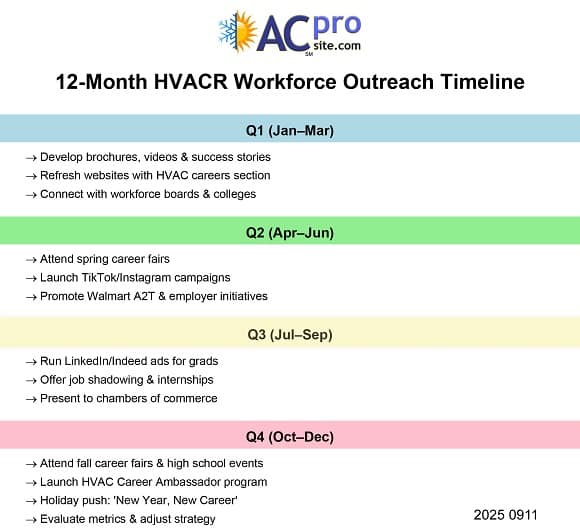
By following this plan, contractors, associations, and schools can steadily build awareness among white-collar entrants that HVACR is a well-paid, in-demand, and fulfilling alternative career path.
This brings us back to where I started these posts about the workforce shortage 4 weeks ago: Contractors are part of the solution. Probably the largest part.
CLICK HERE for a 12-Month HVACR Workforce Outreach Implementation timeline PDF.
Warm regards,
Peter Montana, Director, ACprosite.com
pmontana@ACprosite.com
813.417.6792