





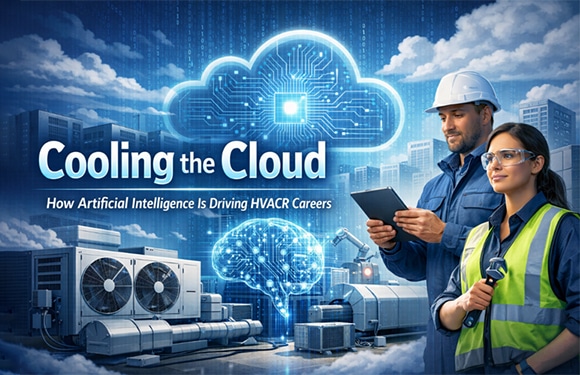
 Not a day goes by that you don’t hear about artificial intelligence in the news. However, did you know that AI is expected to generate thousands of new jobs in the HVACR industry?
Estimates suggesting that artificial intelligence could push the national unemployment rate above ten percent by 2028 have fueled understandable concerns about job displacement and the future of our economy. Interestingly, however, the same forces that are driving automation are also accelerating one of the most infrastructure-intensive construction booms in modern history. America’s digital economy runs on a physical foundation most consumers never see. Artificial intelligence, streaming platforms, online banking and cloud computing all depend on data centers, which are large buildings packed with computer servers that generate enormous amounts of heat that must be disposed of, or at least transferred to areas that will not negatively affect the operation of these systems. Behind the technological headlines is a rapidly expanding mechanical infrastructure whose continued satisfactory operation depends on a workforce of highly-skilled HVACR professionals.
Recent industry reports indicate that roughly thirty-five gigawatts of data center capacity are currently under construction in North America. Data centers are measured primarily by power capacity because electrical load determines computing scale and cooling requirements. Every watt of electrical energy consumed by a server ultimately becomes heat that must be removed. One megawatt of electrical load equates to approximately 284 tons of cooling before any redundancies of design margins are applied. When backup capacity, system losses and uptime requirements are included, installed cooling capacity often ranges from 350 to 600 tons per megawatt.
Even a modest 1 MW data center, which is small by modern standards, typically requires roughly 400 to 450 tons of cooling. That equates to the air conditioning load of about 150 average American homes operating simultaneously. Larger facilities operating at 20 MW to 50 MW require cooling comparable to several thousand homes running continuously. Applying industry planning ranges to the thirty-five gigawatts now under construction results in an estimated 12 to 21 million tons of installed cooling capacity in the pipeline. Depending on plant design, that scale of infrastructure represents the equivalent of several thousand large chillers deployed across new campuses.
Unlike residential systems that cycle on and off with outdoor temperatures, data centers operate 24 hours a day, seven days a week, 52 weeks a year. That equates to 8,760 hours a year out of a possible 8,760 hours! Even a brief cooling interruption can trigger equipment shutdowns within minutes, risking data loss and costly disruptions. The installation of redundant chillers, pumps and power supplies is, therefore, standard practice. Maintenance is constant rather than seasonal. The mechanical infrastructure more closely resembles that of a hospital or industrial processing facility than a typical office building. Growth in artificial intelligence has intensified these demands. Higher server densities generate more concentrated heat, and traditional air cooling is increasingly supplemented by liquid cooling, advanced heat exchangers and sophisticated control systems.
Technicians working in these environments must understand large-scale chilled water systems, cooling towers, variable speed drives and building automation platforms. These highly-skilled workers must also work around high voltage electrical distribution and withing mission-critical uptime standards. Workforce demand reflects this complexity. Data center staffing models vary, but a meaningful portion of operations personnel are dedicated to mechanical and cooling systems. A reasonable planning estimate suggests between 0.2 and 0.6 HVACR or mechanical technician equivalents per megawatt in steady state operations.
As new campuses rise in states such as Texas, Virginia, Arizona and Ohio, competition for experienced HVAC professionals is tightening. Industry groups already report shortages of skilled mechanics, and hyperscale computing adds further strain. At the same time, the opportunity for technicians is significant. Data centers provide year-round employment that is less affected by seasonal swings common in residential service work. Compensation often exceeds traditional HVAC roles because of the technical expertise required and the high stakes associated with failure.
In a period when artificial intelligence is often discussed primarily as a driver of job loss, the physical infrastructure required to power that technology tells a different story for the skilled trades. The cloud is grounded in mechanical rooms filled with compressors, pumps, coils and controls. Behind every streamed video, financial transaction and AI query stands an industrial scale cooling system. Keeping that system running safely and efficiently depends on a growing workforce of HVACR technicians who form an essential link in the nation’s digital infrastructure.
Looking to connect your students to jobs in data centers, attend the data center courses during the National HVACR Education Conference. Then meet with the United Association during the event, who is looking to place people in careers at data centers.